
Onion Taring Line
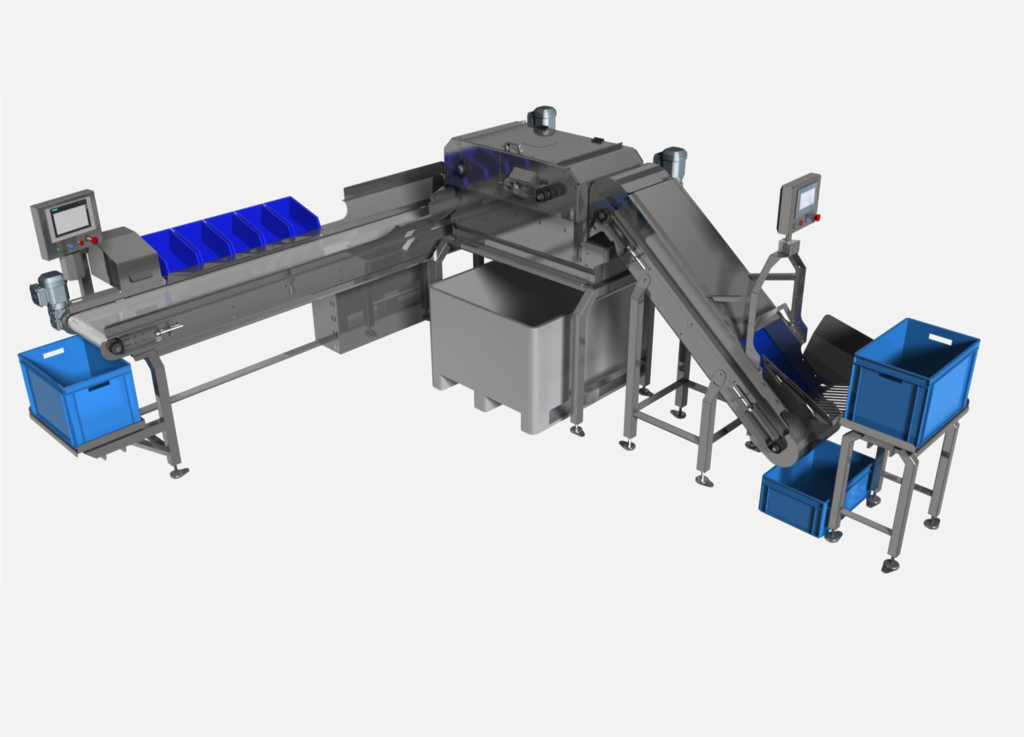
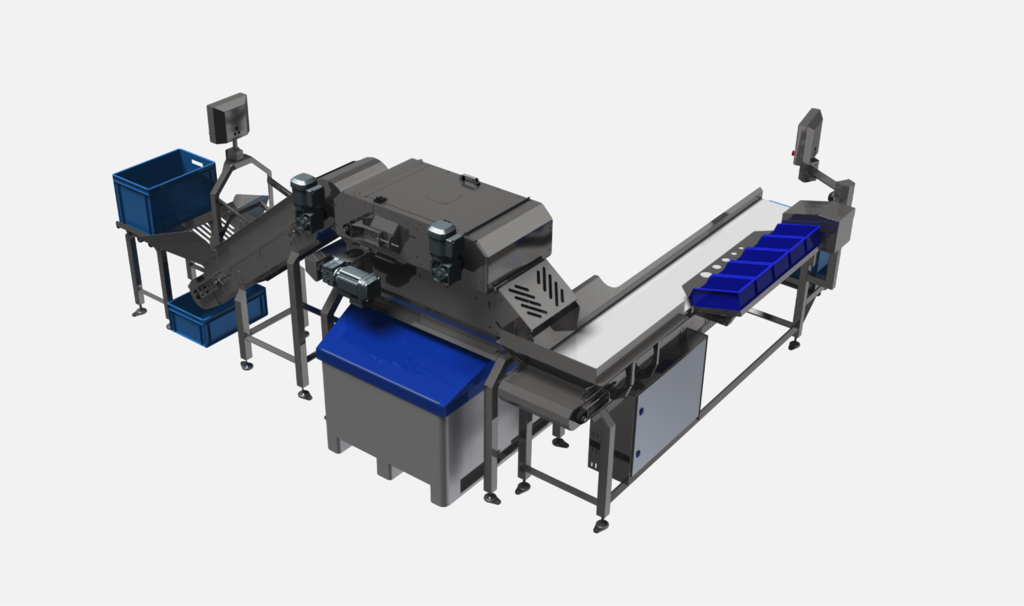
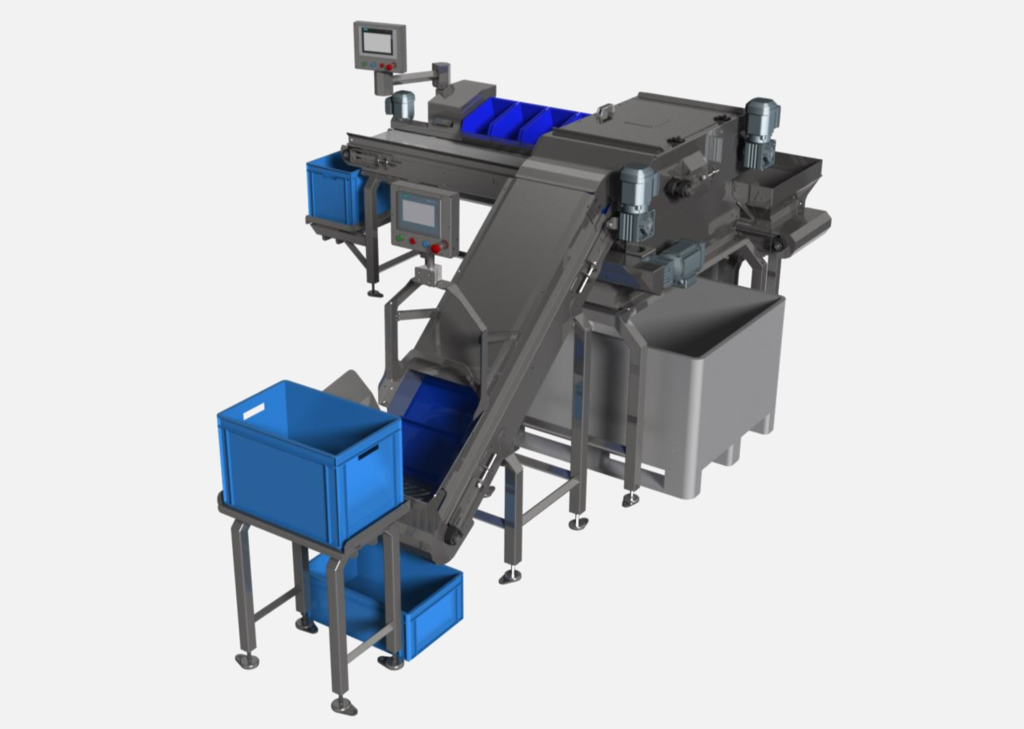
An onion taring line developed by RMA-Techniek for weighing, top tailing and inspecting onions.
RMA-Techniek has built up a lot of experience with onion inspections through the years. We can help you with this by developing a complete onion taring line from weighing onions to top tailing, grading, and sorting. The photos on the right show a few examples of machines and projects that RMA-Techniek has already realized. Below is a brief description of various machines that can be combined in an onion weighing line.
Weighing platform
The sample will be weighed by means of the weighing platform. The box can be placed on the intended platform, and the weight can be read on the screen. After the weight has been determined, the box can be emptied into the hopper. The funnel is designed in such a way that some of the dust and small debris is already filtered out of the sample.
Roller top tailer
The sample is thrown onto the roller top tailer by means of a conveyor belt. The onions fall onto the rollers of the top tailer. The 'tail' of the onion will be pinched off by the counter-rotating rollers.
To ensure that onions do not remain on the rollers, the machine is equipped with an emptying mechanism. This mechanism consists of a number of rubber flaps that rotate over the onions by means of a chain drive. This way the onions are brought to the end of the top tailer where they are further transported in the taring line.
Space is provided under the top tailer to place a box. A tarpaulin is provided to prevent dust from still being released between the box and the machine.
Knife top tailer
The sample is thrown onto the destemmer's bar bed by means of a conveyor belt. Because the bar bed is equipped with an unbalanced motor, the onions are transported over the bar bed and the ‘tails’ of the onions are cut off by a rotating knife mounted under the bar bed.
To ensure that no onions remain on the bar bed, the machine is equipped with an emptying mechanism. This mechanism consists of a kind of comb that sweeps the bar bed empty by means of a pneumatic cylinder. In this way, the onions are brought to the end of the destemmer where they can be transported further in the tare line, if applicable.
There is space under the destoner to place a crate. A cover is provided to prevent dust from escaping between the crate and the machine.
3D camera
A 3D camera can be used to read the sizes of the onions very accurately and display them as a percentage. This system can also be easily expanded with, for example, a sorting system with fingers that can separate a size from the main stream.
Mechanical sorter
In a mechanical sorter, the onions are transported over bars/grids of different sizes by means of shaking. The bars/grids are arranged in order from small to large, so that each size falls between the larger sizes. Weighing bins are suspended under the bars/grids. In this way, the onions are weighed by size.
Inspection table
The inspection table consists of a conveyor belt over which the onions are transported. It can be designed in various ways:
- a row of separate trays with weighing platforms where the different sizes or defects can be sorted,
- a row of weighing trays where the different sizes or defects can be sorted,
- an input screen,
- a printer,
- a weighing platform or weighing tray where the remaining onions are weighed.
If you would like to know more about the possibilities? Feel free to contact us.